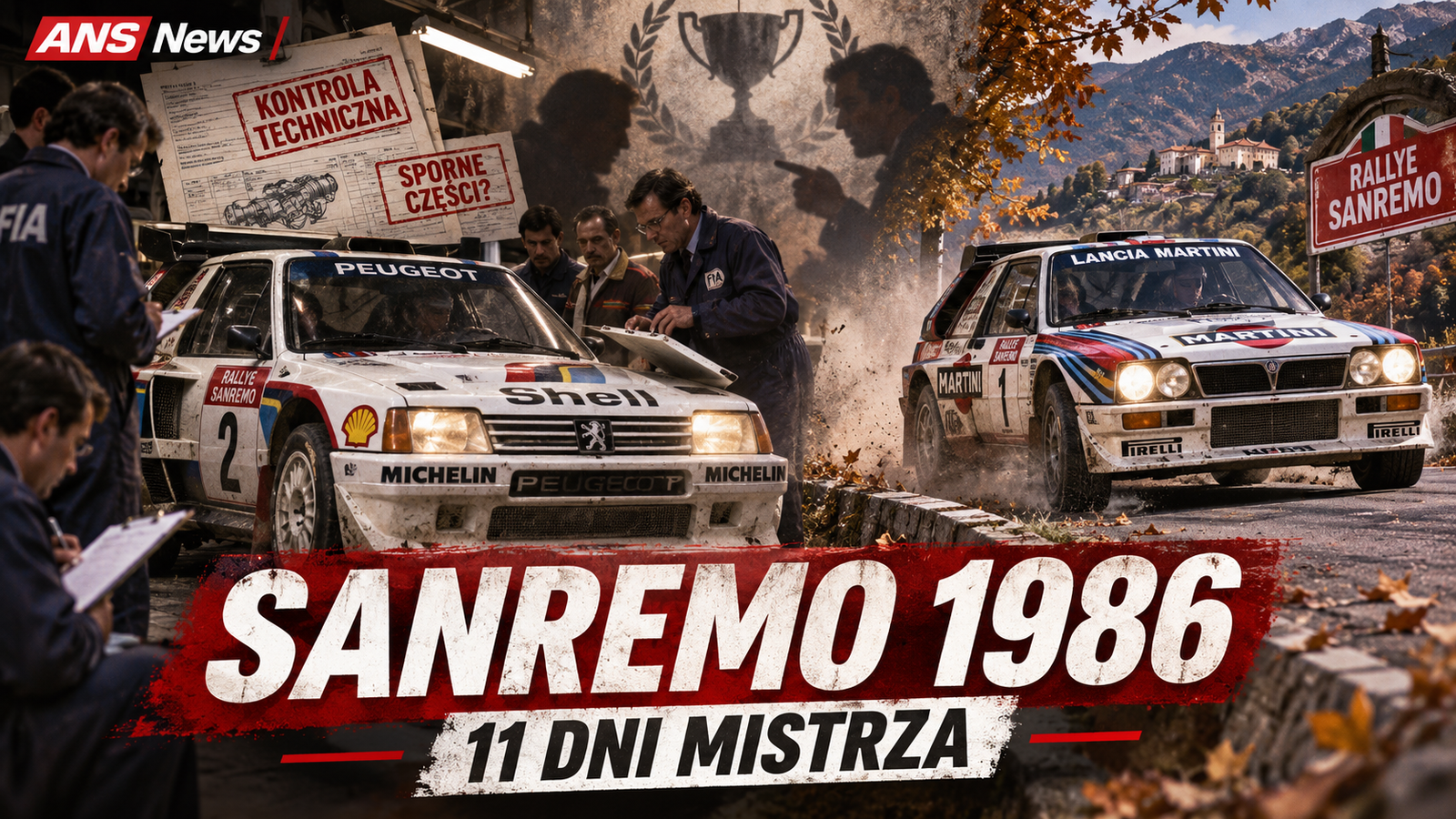
Three factory Peugeot 205 Turbo 16s were excluded from the 1986 Rally of Sanremo for underfloor elements deemed to be illegal aerodynamic skirts. Lancia celebrated victory, Markku Alén could consider himself world champion for 11 days, but ultimately FISA annulled the results of the entire rally. The title went to Juha Kankkunen. On the 40th anniversary of one of the greatest scandals in WRC history, the question returns: how much does it cost a sport to lose faith in its own regulations?
13–17 OCTOBER 1986. THE LAST SEASON OF THE MIGHTY GROUP B
Forty years ago the World Rally Championship was at an exceptionally tense moment.
Following the tragic deaths of Henri Toivonen and Sergio Cresta during the Tour de Corse, the federation decided that Group B cars would disappear from the top category after the 1986 season.
Meanwhile, the fight for the title was still ongoing.
The Peugeot 205 Turbo 16 E2 and the Lancia Delta S4 were among the most extreme constructions of the era.
The Rally of Sanremo, held from 13 to 17 October 1986, was set to be the next chapter of the two manufacturers' rivalry.
Today we recall that story 40 years after one of the most controversial events in WRC history.
THREE PEUGEOTS EXCLUDED. REASON: ELEMENTS AT THE UNDERFLOOR
During the rally, the stewards questioned elements running along the lower sections of the Peugeots' bodywork.
They deemed them to be illegal aerodynamic skirts, the use of which had been restricted following the events in Corsica.
Peugeot maintained that the elements in question were protective parts in the area of the fuel tanks, and that the solution had previously passed technical inspections.
Three Peugeot 205 T16 E2 cars were excluded.
The crews were unable to continue the rally while awaiting the outcome of the appeal.
This proved to be crucial.
Even a subsequent ruling in the manufacturer's favour could not restore the lost kilometres and times.
LANCIA ON THE PODIUM, BUT THE RESULT DID NOT SURVIVE THE SEASON
After the exclusion of the Peugeots, the Lancias moved to the front.
Markku Alén won the rally in the classification announced at the time, ahead of Dario Cerrato and Massimo Biasion.
Historical accounts also describe team orders that helped Alén into first place.
This had enormous significance for the championship battle with Juha Kankkunen.
But that classification did not survive the year.
Peugeot appealed against the exclusion, and the matter was referred to the level of the international motorsport authorities.
11 DAYS AS CHAMPION. THEN THE TITLE CHANGED HANDS
After the final Olympus Rally, Alén could celebrate the world championship.
For just 11 days.
On 18 December 1986, the authorities of FISA, the predecessor of the FIA in governing motorsport, made the decision to remove the results of the Rally of Sanremo from the world championship standings.
Historical accounts point to both the flawed nature of the Peugeots' exclusion and problems related to timekeeping.
After the cancellation of the points from the Italian round, Juha Kankkunen became the drivers' world champion.
Peugeot also retained the manufacturers' title.
It was therefore not a matter of recalculating the finishing positions.
The entire result of the 1986 Rally of Sanremo ceased to have any bearing on the WRC standings.
ONE DECISION CHANGED THE WORLD CHAMPION
The story of Sanremo is unique precisely because a decision taken away from the special stages directly affected the outcome of the entire season.
Markku Alén finished the competition believing he had become world champion.
Juha Kankkunen finished the season in second place.
Eleven days later the situation looked the other way around.
KANKKUNEN BECAME WORLD CHAMPION, AND ALÉN LOST THE TITLE HE HAD ALREADY BEEN CELEBRATING.
This is one of the most extraordinary cases in WRC history.
WHAT DOES THIS AFFAIR SAY ABOUT MONEY IN MOTORSPORT?
A factory rally programme is a huge investment in engineering, personnel, transport, testing and marketing.
Sponsors expect not only logo exposure, but also predictable rules and credible sporting results.
At Sanremo, it was precisely that predictability that failed.
A solution accepted during earlier inspections became the basis for exclusion at the moment when the championship battle was being decided.
There are no reliable public data that would allow the specific financial or sponsorship loss from this affair to be calculated.
However, its reputational cost can be identified.
Instead of remembering only the sporting battle between Peugeot and Lancia, fans continue to this day to discuss the decisions of the stewards and the championship authorities.
DID LANCIA BENEFIT FROM PEUGEOT'S EXCLUSION?
Sportingly, the answer is simple.
Yes.
After the removal of the Peugeots, it was Lancia that took control of the rally, and Markku Alén scored the full points haul.
However, this does not mean that Lancia's involvement in the decision to exclude its rival has been proven.
There are no grounds for presenting as fact the theory that Lancia steered the stewards' decision.
What is documented, however, is:
- the exclusion of the Peugeots,
- the French manufacturer's appeal,
- the subsequent annulment of the entire rally's results
- the change of world champion after the end of the season.
GROUP B WAS ENDING IN AN ATMOSPHERE OF CONTROVERSY
The 1986 season was the last year of the most extreme era in the history of the World Rally Championship.
Group B cars were extraordinarily fast, light and technically advanced.
At the same time, the season was marked by tragic events that led to the decision to end that category.
The Rally of Sanremo added yet another element to this:
a regulatory controversy that affected the world championship.
As a result, the last Group B season entered the history books not only thanks to remarkable cars, but also tragedies, disputes and decisions taken away from the route.
40 YEARS LATER THIS STORY STILL STIRS EMOTIONS
Today, technical regulations are far more elaborate, and cars undergo detailed inspections.
But the fundamental problem remains the same.
Regulations must not only be precise.
They must also be consistently interpreted and enforced.
If a technical solution is accepted during one inspection and later becomes the basis for exclusion at a crucial moment in the championship, faith in the entire system begins to waver.
Sanremo 1986 remains one of the best examples of how a single technical decision can change the history of an entire season.
THE MOST IMPORTANT LESSON AFTER 40 YEARS
The Peugeot versus Lancia dispute should not be reduced to the simple statement that one team stole the championship from another.
The story is far more complicated.
Peugeot was excluded.
Lancia won the rally.
Alén became world champion.
Peugeot successfully fought for the annulment of the result.
Kankkunen regained the championship lead.
And it all happened after the last stage of the season had been driven.
40 years later, the 1986 Rally of Sanremo is a reminder that in motorsport the result at the finish line is not always the last word.
AND HOW DO YOU JUDGE THIS DECISION?
Was the annulment of the entire Rally of Sanremo the only fair solution?
Was Markku Alén unjustly stripped of the championship?
Or perhaps in a situation where Peugeot could no longer return to the competition, there was no truly fair solution at all?
Let us know in the comments.