
Hamilton's 2.75km No-Brake Lap at Silverstone
Hamilton's Silverstone Masterclass: 2.75km Without Touching the Brakes
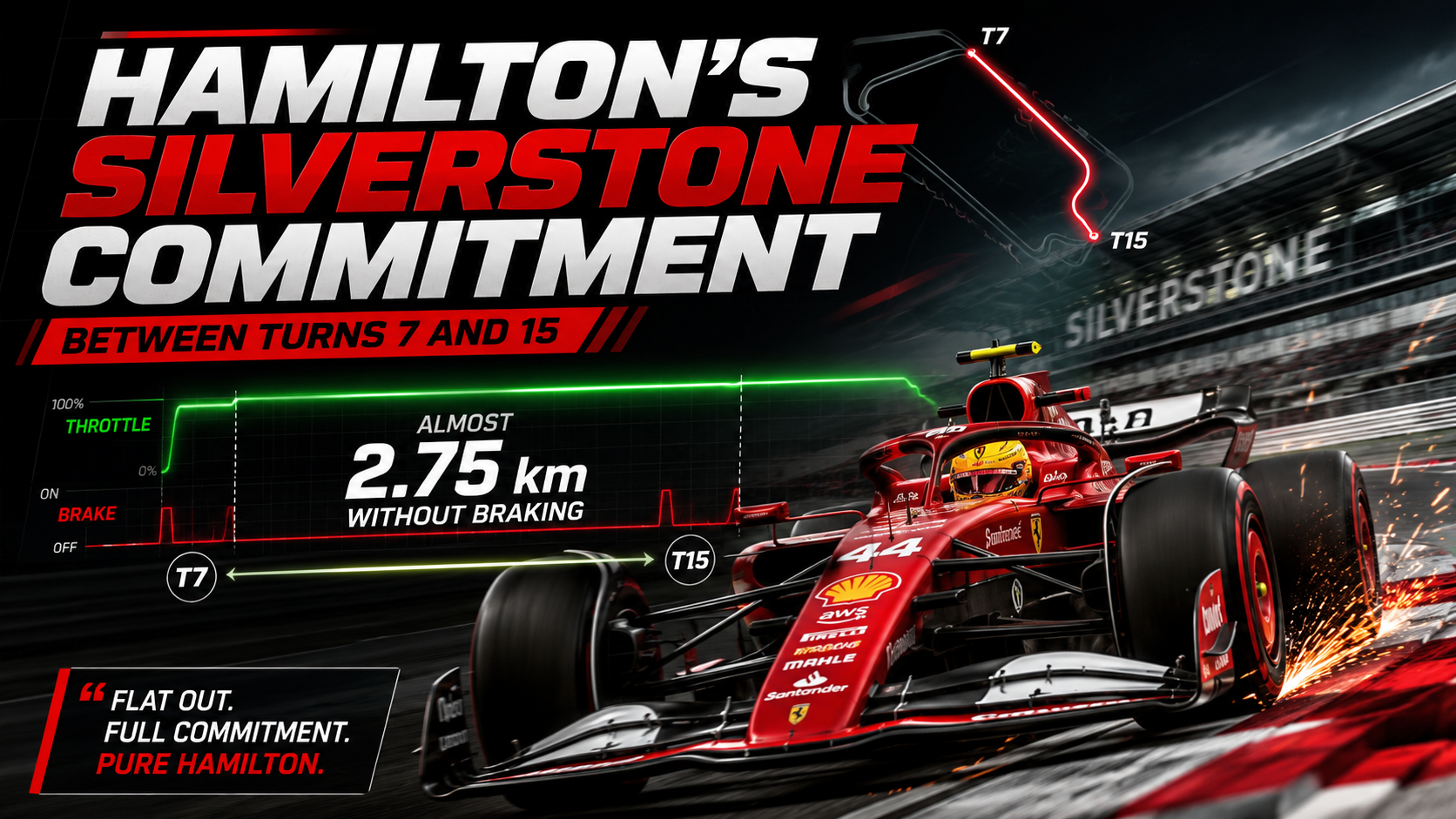
Lewis Hamilton delivered a striking demonstration of commitment at Silverstone, with telemetry data revealing he did not touch the brake pedal for almost 2.75 kilometres during his fastest lap at one of Formula 1's most demanding circuits. The data, shared by F1 telemetry account Holiness, shows Hamilton completed the entire stretch from Turn 7 to Turn 15 without braking, a detail that speaks volumes about the level of precision required to extract a truly exceptional lap time.
A Section That Demands Total Confidence
The run from Turn 7 to Turn 15 encompasses some of Silverstone's most flowing and high-speed corners. This is not a passive section of the track where a driver simply waits for the next braking zone. Every metre demands active management: steering inputs must be precise, throttle control must be measured, and the driver must maintain momentum while trusting aerodynamic grip through some of the fastest corners on the Formula 1 calendar.
Carrying speed through that stretch without once reaching for the brakes means Hamilton had to manage the car's weight transfer continuously, keep the balance neutral, and avoid any input that might upset the platform. A small mistake would not just cost time, it would cost everything the lap had built up to that point.
What the Telemetry Reveals
Formula 1 lap times can look clean and effortless from the outside. The telemetry tells a different story. Hamilton's brake trace through that 2.75-kilometre section is flat, while his throttle trace shows sustained high commitment. Together, they paint a picture of a lap built not on braking power, but on rhythm, trust, and the ability to carry speed where other drivers might instinctively lift.
That distinction matters. A fastest lap achieved through brave non-braking zones is fundamentally different from one gained purely on straight-line speed or late braking. It requires an unusually high level of confidence in the car, the tyres, and the aerodynamic platform delivering the grip.
Silverstone Rewards the Brave
Silverstone has always separated those who commit fully from those who do not. Its high-speed sequences reward drivers who trust what the car is giving them rather than managing risk lap after lap. The circuit's fast, flowing nature means that a driver who hesitates through its signature corners loses time not just at one point, but across an entire sequence of linked corners where momentum is everything.
For Hamilton, Silverstone carries particular weight. It is his home Grand Prix venue and a track where some of the defining moments of his career have unfolded. His connection with the circuit runs deep, and this telemetry detail adds another chapter to that relationship.
A Lap Built on Trust
Perhaps the most striking aspect of this data is what it reveals about trust. Trust in the car. Trust in the tyres. Trust in the aerodynamic setup. Trust in every small input made at high speed. At Silverstone, that kind of trust can be the difference between a competitive lap and an exceptional one.
Hamilton's almost 2.75 kilometres without braking is more than a statistical curiosity. It is a window into the commitment and precision that define elite-level Formula 1 driving, and a reminder of why Silverstone continues to produce some of the most compelling moments in the sport.
Share this article
Press Release+
More from ANS News

Distribution
Part of the ANS News Network
Published by Lemax Ltd
Want to be featured?
Start publishing professional articles across the ANS network — your first one's free
Try Your First Article Free